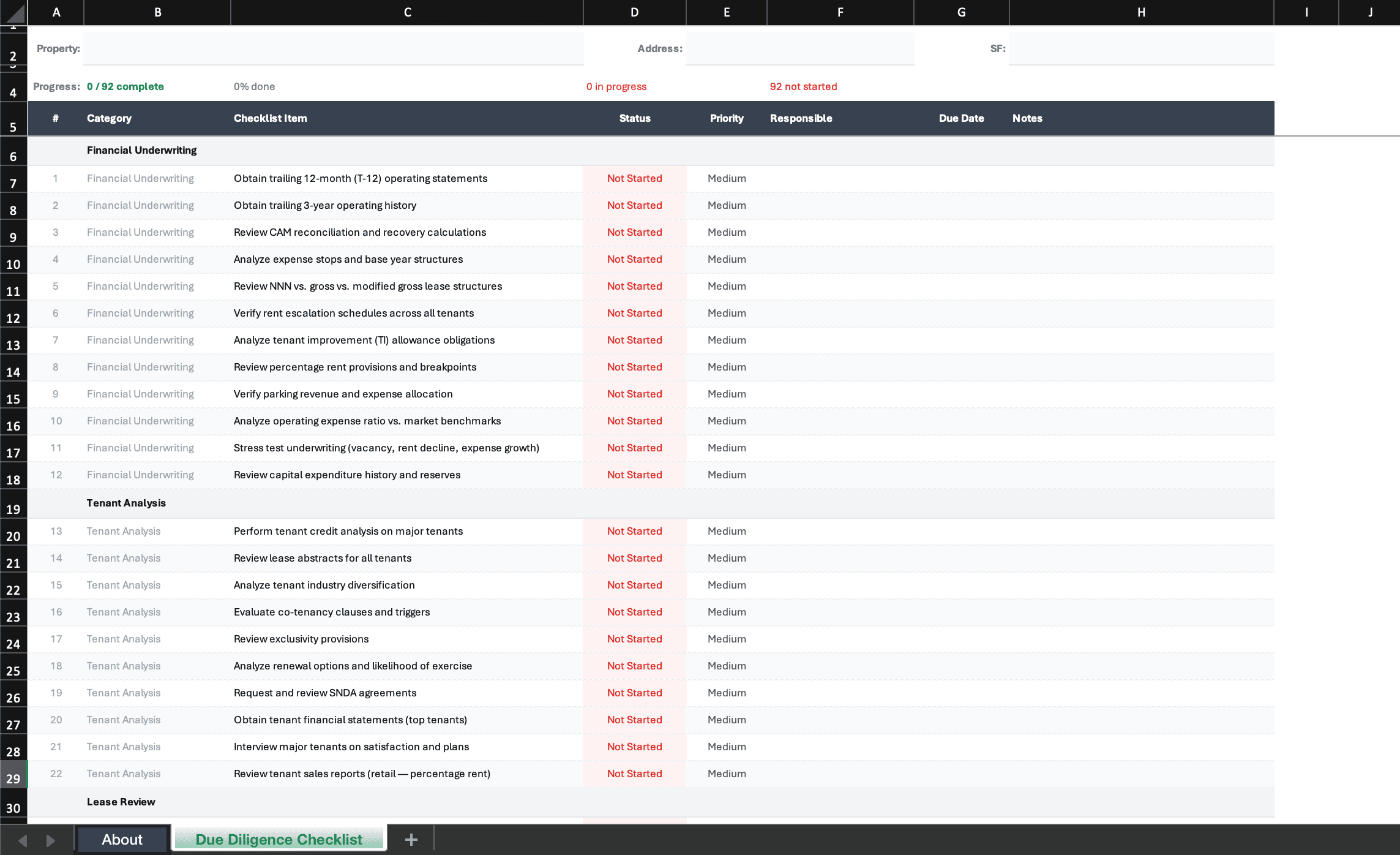
What's included
This template contains 92 due diligence line items organized across 10 categories, built specifically for office and retail property acquisitions. Each item includes a status dropdown (Not Started, In Progress, Complete, N/A), an assignee field, notes column, and due date. A progress bar at the top auto-calculates completion percentage so your team always knows where DD stands.
The checklist covers everything from tenant credit analysis and lease abstraction through building envelope inspection and post-close transition. It is designed for acquisition teams evaluating single-tenant NNN, multi-tenant office, strip retail, and anchored shopping centers.
Office and retail specific items
Commercial office and retail acquisitions require due diligence items that do not apply to multifamily. This template includes specific line items for:
Tenant credit analysis
Review financial statements, credit ratings, and payment history for each tenant. For retail, assess the viability of the tenant's business model and category exposure to e-commerce.
Lease structure review
Abstract each lease to confirm NNN, modified gross, or full-service gross terms. Verify CAM reconciliation methodology, expense stops, base year calculations, and operating expense pass-through provisions.
Co-tenancy and percentage rent
For retail properties, review co-tenancy clauses that may allow tenants to reduce rent or terminate if anchor tenants vacate. Evaluate percentage rent provisions and historical sales reporting.
Building systems
Office buildings require assessment of elevator systems, fire suppression, HVAC zoning by floor, building automation systems, and facade condition. For older buildings, evaluate PCB and asbestos remediation requirements.
How this differs from multifamily DD
Multifamily due diligence focuses on rent roll validation across many similar units, physical unit condition, and turnover cost assumptions. Commercial DD inverts that pattern: fewer tenants, but each lease is a complex legal document with unique terms, escalation structures, and renewal options.
Where a 200-unit apartment building might have 200 nearly identical leases, a 10-tenant office building has 10 distinct lease agreements, each with its own expense structure, TI obligations, and termination provisions. The depth of analysis per tenant is significantly greater, and the loss of any single tenant has a larger impact on property cash flow.
Building systems also differ. Office properties require evaluation of life safety systems, elevator maintenance contracts, and common area HVAC. Retail properties require assessment of parking lots, signage, and ADA compliance across the site.
Categories covered
The 10 categories in this checklist are: Tenant Analysis, Lease Review and Abstraction, Financial Underwriting, Physical and Building Systems, Environmental, Legal and Title, Market and Comparable Analysis, Insurance and Risk, Zoning and Entitlements, and Closing and Transfer. Each category contains between 6 and 14 individual line items.
For teams managing due diligence inside MotionCRE, these checklist items map directly to the task system within each deal workspace. Track DD progress alongside documents, contacts, and deal financials in one place instead of juggling spreadsheets and shared drives.
For multifamily acquisitions, see our multifamily due diligence checklist. Track all documents collected during DD with the deal room document checklist, and manage your broader pipeline with the CRE deal tracker.
Frequently asked questions
What is included in commercial due diligence?
Commercial due diligence for office and retail covers tenant credit analysis, lease abstraction, CAM reconciliation, NNN and gross lease structure review, building systems inspection, environmental assessments, title and legal review, and market analysis. It goes deeper on tenant and lease complexity than multifamily DD because each tenant represents a larger share of revenue.
How is office due diligence different from multifamily?
Office due diligence focuses heavily on tenant creditworthiness, lease structures (NNN, modified gross, full service), co-tenancy clauses, and building systems like elevators, fire suppression, and HVAC zoning. Multifamily DD centers on rent roll validation and unit condition. Office tenants are fewer in number but larger in exposure, making each lease a material risk factor.
What are the key risks in retail property acquisitions?
The primary risks in retail acquisitions include tenant concentration, co-tenancy clause triggers, percentage rent uncertainty, and anchor tenant viability. Physical risks include parking lot condition, ADA compliance, and signage entitlements. Market risks include trade area demographics, competing retail development, and e-commerce impact on tenant categories.
Download this template
Enter your details below to download.
Excel format · No account required